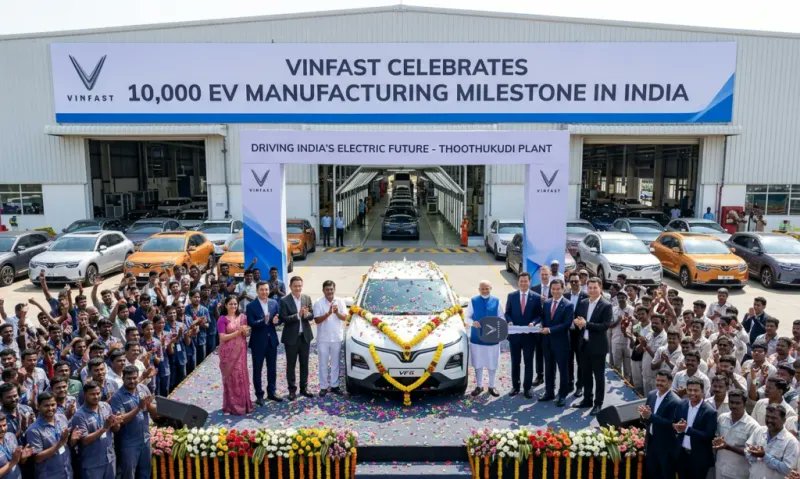
Less than a year in India… and a Vietnamese EV maker just hit a number that usually takes years to reach.
10,000 electric vehicles rolled out in Tamil Nadu.
That’s not a soft milestone. It’s a signal.
And depending on who you ask, it’s either the beginning of a serious EV shake-up—or a bold bet that still has to prove itself.
Table of Contents
ToggleWhat Just Happened in Tamil Nadu
VinFast has officially produced its 10,000th vehicle at its Indian facility in Thoothukudi.
The plant isn’t small-scale experimentation either.
It sits inside the Tamil Nadu industrial ecosystem at SIPCOT and stretches across 400 acres.
Inside the gates:
- Body shop
- Paint shop
- Assembly lines
- Quality control systems
- Logistics operations
And the output target is already aggressive:
50,000 units per year — expandable to 1.5 lakh units.
That expansion clause is where the industry starts paying closer attention.
Must Read: Nissan 118% Surge, Renault 2026 Growth Streak Sparks Big Questions
Why This Milestone Matters More Than It Looks
On paper, 10,000 units is just a number.
But in EV manufacturing, timing is everything.
This plant is VinFast’s first manufacturing base outside Vietnam, meaning India isn’t just a market—it’s a production testbed.
And the lineup already rolling out locally includes:
- VF 6 (midsize electric SUV)
Starting at ₹16.49 lakh - VF 7 (premium electric SUV)
Starting at ₹20.89 lakh
That pricing immediately puts pressure on established EV players who have had years to build brand trust in India.
But here’s the twist—brand trust is exactly what VinFast is still trying to earn.

The Bigger Play: MPV + New EV Expansion
The company isn’t stopping at SUVs.
Its newer model, the VF MPV 7, pushes deeper into family mobility:
- 60.13 kWh battery pack
- 201 hp, 280 Nm torque
- Claimed 517 km range (Indian cycle)
- DC fast charging: 10–70% in ~30 minutes
- Seven-seat configuration
And yes, it comes loaded with connected tech and a large infotainment system.
Price tag: ₹24.49 lakh (ex-showroom)
That places it directly against strong competition like BYD and Kia in India’s rapidly heating EV MPV space.

Market Impact: Fast Scaling, Faster Pressure
Here’s where things start getting interesting.
VinFast has already committed an additional USD 500 million investment in India for:
- Electric buses
- Electric two-wheelers
And it’s part of a broader USD 2 billion roadmap for the country.
So the question is no longer “Is VinFast serious?”
It’s becoming “How fast can competitors react?”
Contrarian View: The Speed That Could Backfire
Not everyone sees this as a smooth success story.
Some industry watchers argue that scaling this quickly in a competitive market like India can create hidden pressure:
- Brand recognition is still low
- After-sales ecosystem is still developing
- Indian buyers are highly trust-sensitive in EV adoption
And most importantly:
EV success in India is not just about manufacturing speed—it’s about service depth.
So while 10,000 units looks impressive, critics say the real test begins after the showroom delivery.
That’s where reputations are actually built—or broken.
What Happens Next
The Thoothukudi plant is now positioned as a potential export + domestic hub.
If expansion hits 1.5 lakh units, the competitive landscape in India’s EV segment could shift faster than expected.
But there’s still one unanswered question hanging over everything:
Can VinFast convert fast production into long-term customer trust in India’s brutally competitive EV market—or is this just an early spike in a much longer race?
Disclaimer
This article is based on publicly available information. No facts, figures, or timelines have been fabricated. Analysis and interpretation may evolve as new data emerges.